Painting Beyond Words
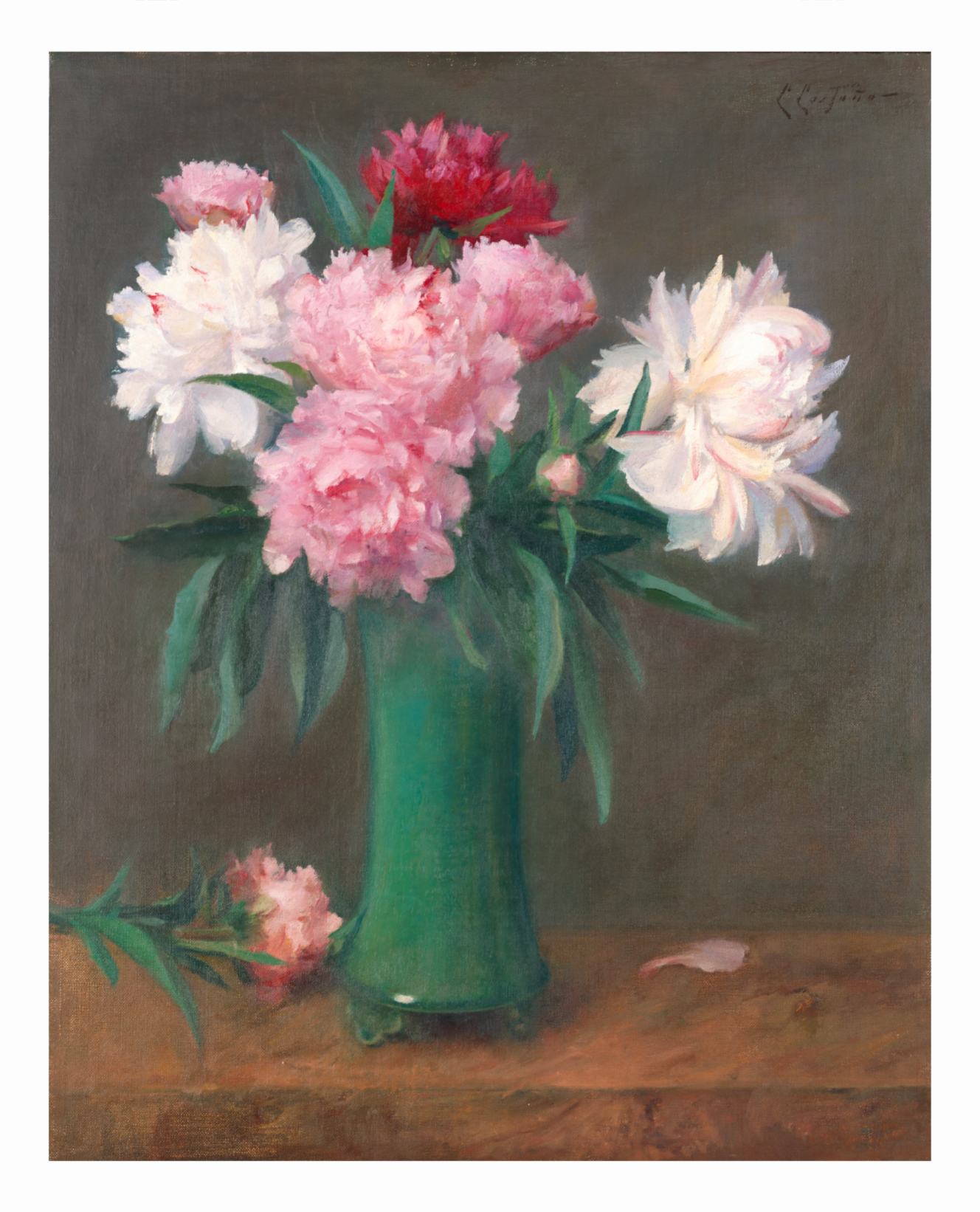
Pink Peonies by Carlos Castano
In Pink Peonies, Carlos Castano transforms a familiar still-life subject into something more intimate and experiential. A bouquet of pink and white peonies rests quietly in a green vase, set against a subdued background. At first glance, the composition feels traditional. But the longer one looks, the more it reveals itself as something closer to a moment of perception than a fixed image.
Edges soften. Petals dissolve into light. Forms emerge gradually rather than being clearly defined. What we are seeing is not simply a depiction of flowers, but an interaction between the artist and the subject—one that prioritizes presence over precision.
This approach places the work in conversation with the broader tradition of Impressionist flower painting, where the goal was not strict realism, but the sensation of seeing.
The Impressionist Flower
In the late 19th century, painters such as Édouard Manet, Berthe Morisot, and Claude Monet began rethinking the role of still life. Flowers, once treated as symbolic or decorative subjects, became vehicles for exploring light, color, and immediacy.
Manet’s peonies, for example, are known for their loose, sensuous brushwork and subtle tonal harmonies. Morisot’s floral compositions often dissolve into fluid strokes, allowing the bouquet to feel alive rather than constructed. Monet, even in his still lifes, allowed forms to shift between clarity and atmosphere.
What connects these artists is a shared belief: that painting should capture how something feels to see, not just how it appears.
A Shared Sensibility
Castano’s Pink Peonies reflects this same sensibility. The flowers are recognizable, but they are not rigidly defined. Instead, they exist in a state of gentle transition—between form and light, between object and impression.
This aligns closely with the artist’s own philosophy:
“The subject dictates the approach… a literal representation is irrelevant.”
Even in still life, Castano treats the act of painting as a responsive process. The bouquet is not imposed onto the canvas—it unfolds through observation, adjustment, and emotional receptivity.
The result is a painting that feels immediate, as though it is still in the process of becoming.
The Role of Atmosphere
One of the most striking elements of Pink Peonies is its use of atmosphere. The background is not empty; it is active, allowing the flowers to emerge softly rather than sit sharply against it.
This technique echoes Impressionist strategies, where space is treated as a field of light rather than a neutral void. The vase anchors the composition, but the blossoms themselves remain fluid, shifting gently within the surrounding air.
This creates a sense of quiet continuity—nothing feels abrupt, and nothing is overstated.
Time, Fragility, and Presence
A single fallen blossom rests on the table beneath the bouquet. It is a subtle detail, but an important one. It introduces time into the composition.
Impressionist painters were deeply interested in the fleeting—changing light, passing moments, and the impermanence of beauty. In Pink Peonies, that same awareness is present. The flowers are not frozen in perfection; they are caught in a moment of transition.
This is where the painting moves beyond decoration. It becomes reflective.
Living with the Work
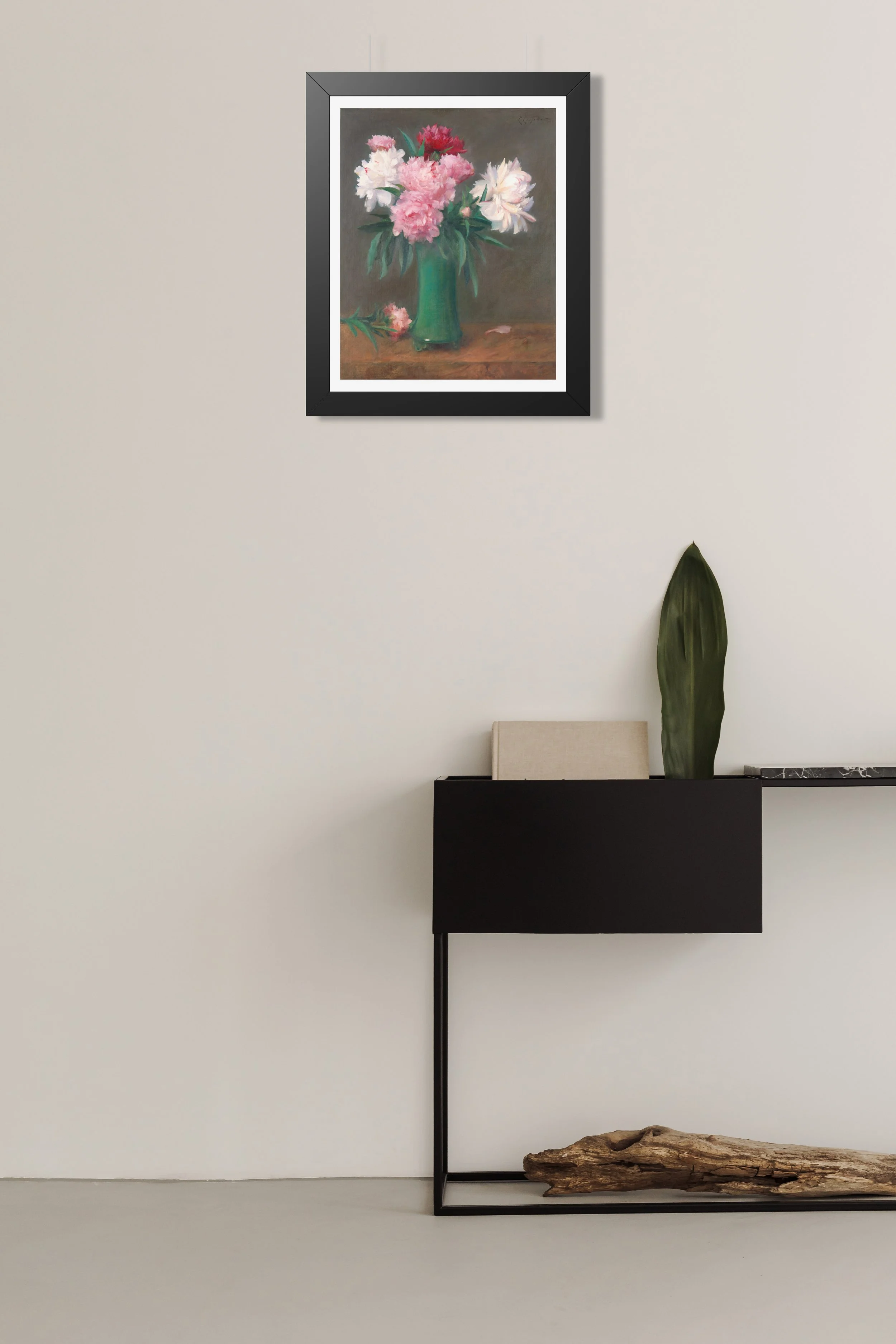
As a fine art print, Pink Peonies carries forward the tactile sensitivity and atmospheric depth of the original oil painting. It is particularly suited to interiors that value calm, subtlety, and emotional resonance.
Rather than commanding attention, it creates space—for stillness, for observation, for a slower rhythm of living.
In this way, the work aligns not only with the Impressionist tradition, but with a broader idea: that art is something to live with, not simply to look at.